

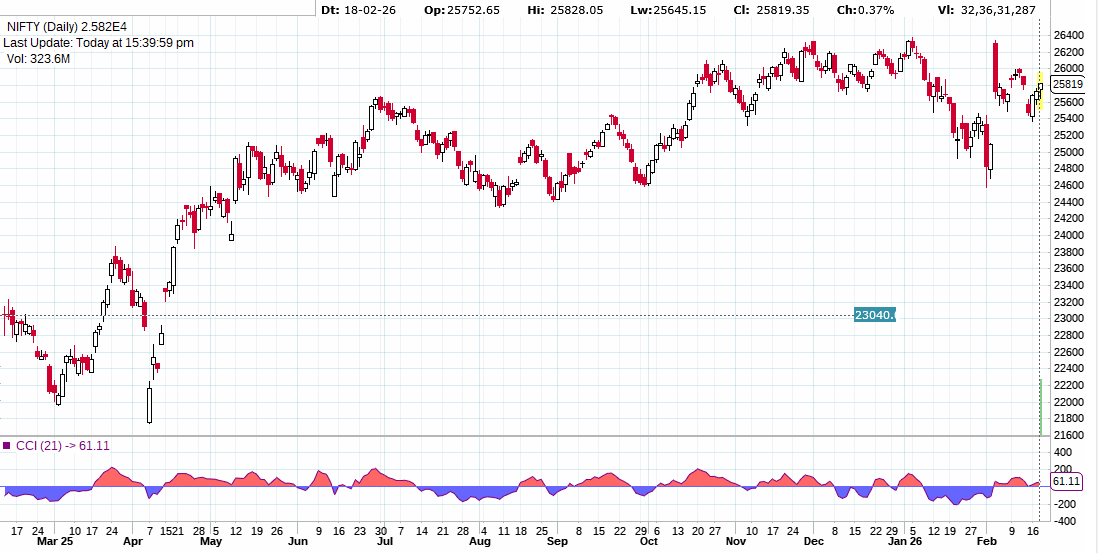
🔍 What is the CCI Indicator?
The Commodity Channel Index (CCI) was developed by Donald Lambert in 1980. It’s a momentum oscillator that measures the difference between the current price and its historical average. Despite its name, CCI is used across all markets — Forex, stocks, crypto, and commodities.
Key levels to know:
- Above +100 → Strong uptrend / Overbought zone
- Below -100 → Strong downtrend / Oversold zone
- Zero line → Neutral momentum; acts as dynamic support/resistance
⚙️ Best CCI Settings for Small Time Frames
Most traders use the standard 21-period CCI setting, while 14-period and 50-period are also popular. For small time frames specifically:
- 1-min / 3-min charts → Use CCI (14) for fast scalping signals
- 5-min charts → CCI (20) works well for intraday momentum
- 15-min charts → CCI (21) is ideal for swing entries within the day
- Shorter period (below 14) → Very volatile, generates many false signals
- Longer period (above 50) → Smoother line, fewer but more accurate signals
Pro Tip: Try using OHLC/4 (Open+High+Low+Close ÷ 4) instead of the default HLC/3 as the price input — many advanced traders find it gives cleaner, smoother readings on lower time frames.
🔑 Advanced Trick #1 — Dual Time Frame Strategy (The Core Trick)
This is the most powerful CCI technique for small time frame trading.
How it works:
- Use a higher time frame (e.g., 15-min) to identify the dominant trend
- Use a lower time frame (e.g., 1-min or 5-min) to find precise entries
When CCI is above +100 on the 15-minute chart, only look for buy/long entries. On the 1-minute chart, wait for CCI to dip below -100 (pullback), then when it crosses back above zero, that signals the pullback is over and the trend is resuming — that’s your entry.
Entry Rule (Long):
- 15-min CCI > +100 ✅ (Trend confirmation)
- 1-min CCI drops below -100, then crosses back above 0 ✅ (Entry signal)
Entry Rule (Short):
- 15-min CCI < -100 ✅
- 1-min CCI rises above +100, then crosses back below 0 ✅
🔑 Advanced Trick #2 — CCI Zero Line Cross (Momentum Shift)
The zero line is often underused but extremely powerful on small time frames.
- CCI crosses above 0 from below → Bullish momentum building → Look for longs
- CCI crosses below 0 from above → Bearish momentum building → Look for shorts
When the short-term and long-term CCI trends agree, you can be more confident in a trade. Always use a higher time frame CCI to define the trend direction, and a lower time frame CCI to generate precise buy/sell signals.
🔑 Advanced Trick #3 — CCI Divergence (Reversal Signal)
Divergence is one of the most reliable signals in CCI trading.
Bullish Divergence: Price makes a lower low, but CCI makes a higher low → Reversal to the upside likely
Bearish Divergence: Price makes a higher high, but CCI makes a lower high → Reversal to the downside likely
CCI divergences work across all timeframes. For small time frames (1-min to 15-min), they offer more signals but with increased noise — so always wait for price action confirmation before entering a trade.
🔑 Advanced Trick #4 — CCI + Moving Average Combo
A powerful combination for small time frame traders:
- Use M15 as the primary time frame for trend context
- Use M5 for actual entry signals
Buy Setup: When CCI leaves the oversold zone (-100) and price crosses a moving average from below simultaneously → Open a buy order.
Sell Setup: When CCI crosses +100 and price crosses the moving average in the same downward direction → Trigger a sell order.
Maintain a healthy 3:1 reward-to-risk ratio — for example, targeting 30 points of profit with only 10 points of risk per trade.
🔑 Advanced Trick #5 — CCI Overbought/Oversold + Trend Confirmation
Many beginners make the mistake of fading every +100/-100 signal. Don’t do this in strong trends.
In strong trends, the CCI can remain above +100 or below -100 for extended periods. Trading against extreme readings in a trending market is one of the most common and costly mistakes.
Correct approach:
- In an uptrend → Use -100 dips as buying opportunities, not reversal signals
- In a downtrend → Use +100 spikes as selling opportunities
⚠️ Common Mistakes to Avoid
- Trading CCI signals in isolation — Always confirm with price action or another indicator
- Ignoring the higher time frame trend — A bullish CCI on a 1-min chart means nothing if the 15-min is in a downtrend
- Using default settings for all time frames — Adjust your CCI period based on the chart you’re trading
- Entering without confirmation — Wait for price action to confirm CCI signals before pulling the trigger
- No stop loss — Always place stop loss below the recent swing low (for longs) or above the recent swing high (for shorts)
📋 Quick Reference — Small Time Frame CCI Cheat Sheet
| Time Frame | CCI Setting | Best Use |
|---|---|---|
| 1-min | CCI (14) | Scalping entries in trend |
| 5-min | CCI (20) | Intraday momentum trades |
| 15-min | CCI (21) | Trend filter + signal chart |
| 1-hour | CCI (20–50) | Swing trade confirmation |
✅ Summary
The CCI is a powerful leading indicator for small time frame trading when used correctly. The biggest edge comes from combining dual time frame analysis (higher TF for trend, lower TF for entry), watching the zero line crossover, and spotting divergences before reversals.
Always manage your risk, and never rely on CCI alone — pair it with price action, moving averages, or volume-based indicators for the best results. With practice and discipline, the CCI can become one of the sharpest tools in your trading arsenal.
Disclaimer: This content is for educational purposes only and does not constitute financial advice. Always do your own research and consult a qualified financial advisor before making any trading decisions.
For more content, you can check here.
You can follow my social platforms here.
700+ YouTube content. You can subscribe to more live content here.
2200+ Twitter postings on live proof here.
Follow the Facebook page for updates.